
Era of Electric Vehicle (EV) arrives! Residential builders respond by offering EV charging sockets!!

Era Of Electric Vehicle (EV) Arrives! Residential Builders Respond By Offering EV Charging Sockets!! Consumer sentiment globally is driving the Automobile industry towards producing high performance, energy efficient Electric Vehicles. With a promise of zero emission and a rapidly increasing environmental consciousness, this global green crusade is underway at a much faster pace than we can imagine. So, if the era of Electric Vehicles has arrived, then we need the equivalent of a gas station, which is a charging station both commercially, and also at our homes or places where we visit. A charging station is a part of infrastructure that supplies electric energy to recharge plug-in electric vehicles. Pertinent questions a home-buyer needs to mull over are: Have we accepted and acknowledged that in a few years, the roads world-over will be flooded with Electric vehicles, and that fuel based vehicles will be eventually phased out? Are our builders thinking about this requirement in the parking slots? More importantly, as home buyers, are we future-ready, and demanding this provision from our builders? Photo by Kindel Media from Pexels The Government of India has adopted a clear mandate to phase out Internal Combustion Engines (ICE), and encourage switching to eco-friendly electric vehicles. There are several incentives being offered under the Faster Adoption and Manufacturing of Electric & Hybrid vehicles in India scheme (FAME initiative). The switch over from ICE to EV is imminent, and will happen only in a matter of time. State Governments in India like Karnataka have adopted aggressive targets to implement EVs hitting the roads over the next two decades. With a projected double digit year-on-year growth of Electric Vehicles in India, the era of electric cars has finally arrived! The key driver for growth and transition remains the cost of lithium-ion batteries, which will continue to nosedive. Consequently, the cost of electric vehicles will be either lesser or comparable to gasoline fuelled vehicles. Builders Offering EVs Charging Sockets: An Impending Need Of Home-Buyers Driven by this reality, the real estate sector is also responding to the futuristic requirements of home buyers that need to be addressed today! Few builders have already made rapid strides towards keeping pace with the emerging needs, and are offering Electric Vehicle Charging slots in parking areas of their residential offerings. This added feature of EV charging sockets requires upgraded and additional load taking capability in the buildings. The parking slots with charging stations are enabled with sockets and connectors to plug into the Electric Vehicle. Technicalities Of EV Charging Photo by Ed Harvey from Pexels To understand the technicality- akin to mobile phones, the charging cable has two ends. One end plugs into the vehicle, and the other end plugs into the charging socket. There is variation in the type of connectors depending upon the type of vehicle, and the speed-of-charge itself. The charging speed could be a) slow/fast charging, or b) rapid charging, and may vary depending on the country specific infrastructure and product-line of Electric Vehicles being offered. GIven below are some more technical details for a better understanding of EV charger types- Slow & Fast Charger Alternating Current (AC) This is typically used for charging at home, work or other places of visit. The socket is universal across all electric ranges, and can be thought of as similar to the USB socket for charging smartphones. The socket remains the same for each, but the cable is specific to the car type. Rapid Chargers Direct Current (DC) These have tethered cables that are compatible with the car-side connectors alone. These are used commercially, and within India alone, we may have a rapid charging station at every 3 KM distance in the near future! Future of EVs in India Photo by Kindel Media from Pexels Reliable projections peg India to have approximately 40% electric vehicles over the next one decade. Futuristic builders are providing for AC slow/fast charging sockets at their residential apartments as a back-up emergency option. although the preferred option will be a rapid charge DC available commercially, just like going to a petrol-bunk for petrol or diesel refuelling in India. Conclusion The commitment to switch to Electric Vehicles in India is carved in stone. The Indian Transport minister made a very forceful remark in 2017 about moving India to being a 100% Electric Vehicle country by 2030. Ofcourse, post some deliberations later, this number was brought down, but what matters is the clarity of thought, direction, and an unwavering commitment towards non-pollution. Overall, the good news is that earth will see a cleaner, greener and brighter tomorrow in the very near future! Home buyers in the very near future will need exclusive EV charging points in the parking areas of their apartments, and it’s important to be cognizant of this imminent need. To know more about “Top 5 ‘electrical’ specifications in an apartment“. Click Here!
Robosand Vs. Natural sand: a Trade-Off?

RoboSand vs Natural Sand: Which Is Better? | Avisun Properties Traditionally, construction materials like ‘concrete’ require mixing of cement, river-sand, larger aggregates (gravel), and water. With the unprecedented growth of construction industry world-wide, procuring ‘river-sand’ is becoming more difficult and costlier with every passing year. Global regulations are applying brakes over the excessive exploitation of river-sand. With this scenario emerging, manufactured-sand or robosand has now become the most preferred substitute. Besides, ‘river-sand’ is almost two to three times costlier than robosand owing to the over-exploitation and receding supplies of river-sand. However, home buyers are not fully aware of robosand, and having questions lurking in their minds about the suitability and safety of this substitute to river-sand. In this article, we are focussed on evaluating and understanding river-sand and robosand from a home-buyers’ point of view. Understanding the basics: river-sand, desert-sand & sea-sand ‘River sand’ has been used for concrete mason work, and requires very little water. River-sand or natural-sand has better texture, is smooth and round in shape with extremely low ‘silt’ and ‘clay’ content. ‘Silt’ is super fine material that is not good for construction. ‘River sand’ contains very less of silt making it an ideal raw material for construction. Similarly, ‘clay’ does not allow cement to bond, and ‘river sand’ has very little clay content that is ideal for making strong concrete. River-sand contains small parts of rock in sand size, and owing to natural occurring, it has all kinds of sizes that makes is suitable for construction. Some of us may wonder: can we not use ‘desert sand’ or ‘sea sand’ that are available in abundance? The answer is a big ‘no’! ‘Desert sand’ and ‘sea sand’ are useless for construction purposes. Here’s why: ‘Desert sand’ is too fine and smooth hence not well-graded (unsuitable for construction), and sea sand is a result of sand eroded by sea which contains corrosive salts. Sea-sand has poor compressive strength, and extremely low tensile strength that makes it unfit for construction. It’s interesting to know that countries like U.A.E (specifically, Dubai/Sharjah) which are sitting in the middle of Arabian Desert import river-sand from countries like Australia. This is done because the ‘right sized’ river-sand particles are ideal for strong concrete and landfilling. Robosand: a substitute to river-sand River-sand being the ideal raw-material for construction became a bane for the rivers, posing serious environmental threat. Rivers have been plundered recklessly to feed the immense growth of world infrastructure. Unprecedented and criminal use of sand has created an ecological imbalance! It takes thousands of years for sand to form along the river beds, and there is no way to replenish it once taken. Mankind cannot be allowed to deplete the river-sand deposits incessantly. So, the alternative to river-sand that works very well is ‘manufactured sand’ or ‘robosand’ which is pegged to be cheaper, better, and environmental-friendly! Home Buyer’s Thoughts: Is Robosand a ‘Good Substitute’ Or a ‘Compromise’? For a home buyer, being environmentally sensitive may not be a priority. So, if a builder uses river-sand or robosand, or both, we get sceptical. We wonder why that happens, and get suspicious on the quality front. The ultimate goal for every home buyer is to have a strong, durable, long-lasting, and safe home that can withstand all the natural calamities, and various other known/unforeseen pressures over the decades. Without the right knowledge, a home buyer may end up fostering negative perceptions and apprehensions about the ‘quality and suitability’ of construction materials like robosand! Questions that might trouble a home buyer are: Which is better for construction of my home: robosand or river-sand? Which of the two results in a stronger building in the long run? Which one is my builder is using, and why? If robosand is being used, am I being adversely impacted cost-wise or otherwise? By using robosand, is my builder trying to make more money by compromising on something? Does my builder have the expertise to use robosand well to create a strong, study, safe and secure building for my family? Well, to clear this mist around such suspicions, a home buyer must understand the properties and usage of both river-sand and robosand. [Source:https://robosand.weebly.com/] River Sand vs. Robosand: An understanding Sand, or more specifically, River-sand works as ‘fine aggregates’ in concrete and mortar that is used in the construction of a variety of civil engineering structures. Being a gift from mother-nature, river-sand has come into existence due to the ‘weathering of rocks’ over tens of thousands of years. Owing to its suitability, river-sand has been mined excessively from the river beds over the last two centuries for construction work. Manufactured sand (m-sand) or robosand, as the name suggests, is manufactured from stone-quarries ‘replicating’ the mother-nature’s method. A ‘Rock-Hit-Rock’ crushing technology or ‘VSI technology’ (Vertical Shaft Impact) is deployed to manufacture robosand. Rocks are continually blasted using this technology, and after a multiple cycles of crushing, they are reduced to the size of a natural sand particle. Fine particles and impurities are cleaned/washed away till they become fit to be used as ‘construction aggregates’ similar to river-sand. The reasons for manufacturing robosand are: i) in response to the global scarcity of natural river-sand, ii) growing global demand of ‘fine-aggregate’. iii) high transportation costs of natural sand due to locational constraints, iv) inherently high presence of silt and clay (impurities) in river-sand. Robosand: The Advantage The advantages offered by robosand are: i) cost-effective compared to river sand, ii) environment friendly, iii) lesser impurities resulting in ‘higher ability to withstand extreme pressures’, better resistant to abrasions, higher concrete strength compared to river-sand. Usage of robosand actually enhances the strength of the building, although it entails using higher proportion of cement to gain the optimum concrete strength. Robosand vs. River-Sand: Properties & Differences Factors Robosand River sand How it’s made Factory made Nature’s gift Moisture-factor for binding concrete Moist only upon being washed Naturally locked moisture creating concrete better Size & shape Angular aggregates, rough texture; implication- need more water & cement Being smooth
Which Is Better? Ready Mix Concrete(RMC) or Miller?
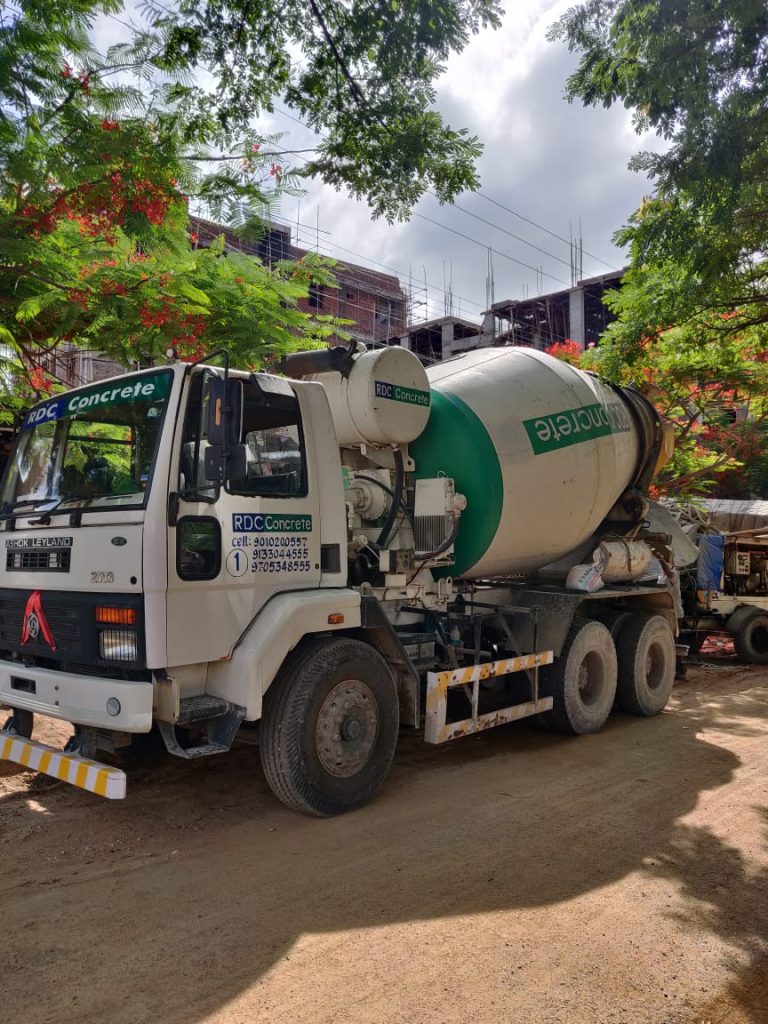
Which Is Better? Ready Mix Concrete(RMC) or Miller? We often see construction ‘Ready Mix’ trucks carrying big ‘concrete mixer tank’, bearing names like Birla Ready Mix, UltraTech Ready Mix, ACC Ready Mix and so on. Adorned with huge spindle-shaped tanks, these trucks catch our attention. Let’s ponder: As home buyers, should we look only for homes/apartments made with the most modern equipment like RMC mixer? If we see an old school manual ‘Miller’ being used for construction of our home, does that mean we are getting a sub-standard home or apartment that lacks sturdiness? What if the ‘columns’ or ‘slabs’ in our apartment/home are crafted with the old-timer manual ‘Miller made concrete’? Would it mean that the builder has gotten us befooled? Well, let’s explore the answers to these! Fact is, even today, we still see builders using the drum/pan type ‘manual’ concrete mixers or ‘Millers’. Not everyone uses ‘Ready Mix Concrete’ every time. Surprisingly, at times we see builders using both the options- ‘RMC’ as well as the ‘traditional Miller’, with a very specific purpose. Why do they do so? Is there any scientific basis for using both options? Should the home buyer be worried about which ‘concrete-making option’ has been used by the builder for making ‘columns’ and ‘slabs’ of their apartment/home structure? Is it really a question of ‘which to choose’? RMC vs. Miller?’ When pouring a ‘slab’ or ‘columns’, the builder is faced with a decision. Should the builder use the old school Miller, or move with the times to order RMC (Ready Mix Concrete) trucks from a plant? To answer this question, let’s first understand the ‘pros & cons’ of both these options. As a home buyer, we might view both RMC and Traditional Millers as mere construction equipment, the former being comparatively newer. Home buyers don’t normally dig deeper to understand the uses of both the options, and implications in the making of our home. To gain a balanced perspective, let us first learn about their ‘pros and cons’ of bot “RMC’ and ‘Miller’. So, let’s understand ‘why, when and where’ these two are used, and their role respective in shaping-up our dream home. Understanding the basics: RMC & Miller (traditional mixer) Ready Mix Concrete [Source:indiamart.com] Defined by the Indian Standard IS specification, ‘Ready Mix Concrete’ is “concrete mixed in a stationary mixer in a central batching and mixing plant or in a truck- mixer and supplied in fresh condition to the purchaser either at the site or into the purchaser’s vehicles.” So, Ready Mix Concrete is a ‘ready-to-use’ material when it arrives at the site loaded in a truck. It is made as per the ‘concrete mix ratio’ recommended by the Civil Engineers or contractors, and delivered directly to the site using ‘cement mixer trucks’. RMC consists of a certain proportion of mixture comprising cement, sand, aggregates and water. A thorough mixing happens in the ‘concrete mixing transport truck’ that carries this mixture. During transit, i.e. from the plant to the construction site, the mixture is made ‘vibrant or alive’. The spiral shaped blade inside the tank of the RMC transit-mixer truck not only mixes the ingredients, but also keeps them in liquid shape during transportation. Once it reaches the destination, the concrete needs to be used within a stipulated time, else the mixture becomes unusable due to ‘setting’. Ready Mix Concrete(RMC) is made with the objectives of producing better & consistent quality of concrete, eliminating inconsistencies of storage space at the construction sites, eliminating the conventional hiring of machineries/millers for making concrete, and to avoid the wastages of raw material at the site. While this technology evolved in 1903 in Germany, in India, RMC was first used in the construction of Bhakra Nangal Dam in the 1950s. Miller (Concrete Mixer) Photo by Rodolfo Quirós from Pexels A Miller (Concrete mixer) evenly combines ingredients like cement, sand and water to form Concrete. A revolving drum is used to mix the ingredients well. The millers are normally smaller, and portable, and can be easily transported to the construction site. This allows the masons and worker adequate time to apply/use the concrete before it hardens. Concrete components are mixed in a certain pre-determined ratio to give the desired consistency. Consequently, this requires precision and meticulous work to avoid quality issues. Pros & Cons: RMC vs. Miller Both these options have their pros and cons as listed below Miller:Pros: Photo by Edgar Toro from Pexels https://www.longbeachconcreteservice.com/ Cons: RMC:Pros: Cons: The verdict Is it really a question of which is better? With the high ‘cons’ for Miller, and too many ‘pros’ for RMC, it might seem that using RMC alone is the most reliable option. However, the reality is not so. Both can be effectively used depending on the purpose. Depending on the scale of the project, the builder may use both Miller and RMC technology to optimize on the advantage accrued. Either way, the reality is that majority of the builders out there use miller to fill up their ‘columns’, and the RMC trucks to lay the ‘slab’. Having understood the ‘pros’ and ‘cons’ of both the options (RMC vs. Miller), this reality would make immediate sense to the reader. By using Miller, the quality of the concrete can be enhanced or optimized to address a specific set of objectives. Considering that the entire load of the building rests on the columns, a Miller used-well is a very safe & sturdy option, and guarantees greater building strength & longevity. Similarly, for slabs (roofs) that sometimes run into thousands of square-feet, using RMC effectively within the stipulated timeframe is the best way to cover large areas with a slab within a short span of time. This understanding helps the home buyer gauge the benefits that accrue by using either of these options in varied contexts. To conclude, both RMC and Miller enhance the overall durability and life of our home with an objective-driven deployment and construction-strategy! To know more about “Tips to check ‘construction quality’ of an apartment in a ‘standalone
Buying a New Home?Have The Right Checklist Before Booking Your Apartment Or House

Buying a New Home ? Have The Right Checklist Before Booking Your Apartment Or House Understanding the difference between three factors is extremely critical for a new home buyer viz. Legal factors, Extraneous factors, and Intrinsic factors. Normally, when we browse for a checklist or consider buying a new home, we tend to focus on two things: ‘legal factors’ and ‘extraneous factors’. ‘Legal factors’ comprise things like ownership, conversion & land permissions, occupancy certificate, RERA compliance and other statutory approvals. The ‘extraneous factors’ comprise considerations like buyer-requirements, unit size, family & lifestyle needs, location & access preferences, amenities, possession time frame, budget & financials, purpose of investment, and so on. Image by Gerd Altmann from Pixabay What is missed out by most of the new home buyers is a checklist of ‘Intrinsic factors’ that help us understand what goes into the making of a building, and ‘what to expect’ with the type, grade, quality and brand of construction materials used! Clearly, new home buyers either give very little focus on these ‘intrinsic factors’, or, worse still, don’t realize the importance thereof. Satisfying critical ‘intrinsic factors’ makes a builder trustworthy! While the legal matters and requirements are on top-of-the-mind, the intrinsic factors gain very little attention from the home buyer. This makes the new home buyer vulnerable, and at times, builders deprioritize this critical aspect! A home-buyer rarely dig deep into aspects that make the building sturdy in its ability to handle natural calamities, and umpteen threats that thwart the building’s structure. Furthermore, with very little knowledge about the types, grades and quality of materials, the pre-construction rigour, and the on-going processes, the incentive for long-term accountability for the building’s health gets compromised. A strong and sturdy building has the ability to withstand natural calamities, fight the threats like soil-related issues, and is bereft of termites, electrical issues, dampness, plumbing issues, cracking/chipping of walls, a deteriorating look, corrosion of the structure, and many other woes that can wreck a havoc. The real issue is that our knowledge is only skin deep, and a new home buyer knows very little about ‘what to expect’, ‘what to accept’ and ‘what to reject’! Many times, builders & developers take advantage of this, and succumb to the temptation of operating with a ‘give bare minimum’ formula, and cut corners on critical construction-related specifications & standard-operating procedures. These builders somehow force-fit and strike a dangerous trade-off between their own financial interests, the buyer’s lack of awareness/budget. As a result, the buyer ends up buying a low-grade home that may not last the test of time, and, in a worst case scenario, deteriorate beyond redemption or even collapse!! Having a classy external finish, and adhering to legal requirements is not good enough! A home buyer must be knowledgeable about factors that determine the health of their building that gives a good living experience as decades go by. Homebuyers need to be aware of the ‘intrinsic factors’, and demand evidence of what goes into the making of their dream home. What are some of the oft-ignored ‘intrinsic factors’? Intrinsic factors go beyond the specifications mentioned by the builder. Some important ones are: Pre-construction rigour: Critical decisions based on Soil testing Extremely high focus on Anti-termite treatment up to plinth level TMT bars like FE 500d quality steel e.g. SRMB, TATA Tiscon, Vizag, JSW Branded high-grade Cement e.g. Ultratech, Shree. Ambuja, ACC Main door frame & sheet of teakwood UPVC windows of reputed make Weatherproof exterior emulsion Fire-retardant concealed copper wiring e.g. Havells, Finolex, KEI Distribution boards and MCBs e.g. Anchor, Havells, Finolex, Schneider Vitrified tiles of reputed make Acid resistant tiles in bath & washroom CP & Sanitary fitting e.g. Parryware, Hindware, Jaquar, Roca Lifts & elevators e.g. Mitsubishi, Otis, Kone, Johnson, Schindler Acoustic enclosed DG generators e.g. Kirloskar, Mahindra, Mitsubish Do these intrinsic factors impact a new home buyer? Let’s explore… Given below is a list of factors, specifications, and some insights about the ‘what, why and how’ of things that should matter! The more you explore, the better you get at your knowledge of critical intrinsic factors. Soil-testing rigour At times builders hide or undermine the importance of soil-testing! Construction done without a soil-test may cause a building to collapse over time!! Soil testing measures the type of land plus its strength to bear the building’s load. Unstable, untreated soil causes the foundation to crack! Soil testing reveals ‘water content’ in soil. High water content is gradually replaced by ‘air’. 10 % ‘air trapped’ reduces concrete strength by 40%! Soil testing helps identify ‘acid sulphate soils’. Acid soils release sulphuric acid which degrades concrete & steel structures to a point of failure! Soil testing provides a ‘hazard mitigation plan’. It helps maximize quality & safety against rains, water-logging, storms, earthquakes, and much more! Proper soil testing helps save lives!! Absence of soil-testing & poor soil treatment weakens the foundation, and even triggers collapse of a building! Anti-termite treatment Pre-construction anti-termite treatment prevents termite infestation! Not all builders take measures to make a building safe from termite attacks!! Anti-termite treatment helps treat the soil in immediate contact with the foundation & floor structure. These insecticides kill or repel termites! Termites may bite, sting, and even cause health issues! Living in homes infested by termites may cause allergic reactions or even asthma attacks. Formosan subterranean and Asian subterranean termites are 2 species causing almost $40 billion annual economic impact from termite damage worldwide! Builders at times pass the risk of termites to home buyers by NOT treating the soil beneath the building and around foundations against termites! RCC structure with FE 500d quality steel RCC stands for reinforced cement concrete, and is used to add strength to beams, lintels, roofs, slabs, stairs and so on. RCC along with steel bars adds the required strength to the building, which can handle high tensions and pressures of the load of a building ‘FE 500 D’ is an anti-corrosive TMT with superb bendability. Compared to FE 500, ‘FE 500 D’ has more ductile strength to withstand enormous pressures! Made with pure iron ore, reputed brands like TATA TISCON 500D are created using a robust metallurgical refinement process that
Green Spaces And Trees Around Sainikpuri Locality Attracting Home Buyers In Hyderabad

Green spaces and trees around Sainikpuri locality attracting home buyers in Hyderabad [Source- https://tinyurl.com/2yfarumz ] Sainikpuri and Yapral locality in Hyderabad is surrounded by a thick green cover. The main reason for this is the Army installations around this area. During the 1960’s, the Sainikpuri area was carved out for retiring Armed Forces personnel. Retired Armed Forces officers developed the colony into a posh area that is akin to living in the serene environments of cantonment. The residential plots in Sainikpuri, Vayupuri are large, and measure between 700 square yards to 2000 square yards. No wonder, you get to see many large lawns with beautiful plants and trees in most of the homes. Over a period of last 30 plus years, the trees have grown thicker. In the 1990’s the trees cover in Sainikpuri was not so thick, and some tree saplings that were planted are now full blown trees. During monsoons, the branches of these trees are trimmed so that they do not interfere with the electricity wires hanging by the pole to cause short-circuit. 1. Lush green spaces and a superb layout of Sainikpuri locality [Source-https://tinyurl.com/4aa8vthx ] Roads in Sainikpuri are large, and range between 30 feet to over 70 feet wide. They are well laid-out and carefully numbered. Avenues, radial roads, and crescent roads are lined with a variety of flowering and fruiting trees. This makes Sainikpuri an area that’s a pure delight to walk into. You have 4 dedicated gardens measuring over 2 acres, and being maintained well. The GHMC park in the E sector of Sainikpuri draws many visitors daily. The chirping of the birds and insects add to the peace and quiet of Sainikpuri. 2. Cantonment like feel in Sainikpuri [Source-https://tinyurl.com/ym2yjp3y ] The Armed Forces areas like EME Centre, MCEME, and the College of Defence Management are almost like an extension of Sainikpuri. A drive around this area is very relaxing. The trees and green spaces around this area welcomes and relaxes you beyond compare! The RSAOMI (Rajendra Sinhji Army Officers Mess & Institute) known earlier as Rajendra Sinhji Institute is located barely 3 KMs away from Sainikpuri. You have a lush green patch of Bhavans School and College in Sainikpuri with a sprawling campus of 50 acres right next to the Defence colony in the Sainikpuri locality. People from all parts of the country aspire to settle down in and around Sainikpuri. Even NRIs prefer to call Sainikpuri locality home. The adjoining colonies that sprang-up over the last 3 decades have also picked on the unique traits of Sainikpuri and Vayupuri. Consequently, these colonies too are extremely well-planned well-laid out adorned with spacious roads, and tastefully constructed homes. 3. Eateries around the green environs of Sainikpuri [Source-https://tinyurl.com/ktan5ukx ] The area is lined with many eateries that add to the charm to this place. Because of the thick green spaces, these eateries are increasingly becoming popular for a relaxing time-spent with family and friends. Some of the notable outlets include- The Coffee Cup, Ram Ki Bandi, Lavish, The Joint Al-Mandi, Vivaha Bhojanambu. Groove9, W-Café by Wichway, Concu, Eatalia Dhaba, f3 Café and Bistro, HYJACK Drive-in, Bayleaf Bistro, Hang Out, The Nosh Bistro, Sholay Café, Mama Mia Italia, Amchi Café, Café Avail, Coffee & Cakes among many more. 4. GREEN-COVER of Sainikpuri locality- benefits and joys! [Source-https://tinyurl.com/2p8hapmm ] [Source- https://tinyurl.com/3cf96p7f] [Source-https://tinyurl.com/ms4fmzre ] Health and social well-being is much higher compared to suffocating concrete jungles in other parts of Hyderabad Trees in and around Sainikpuri promote physical and mental health- Reduced stress, increase in concentration, increase in attention and self-discipline Reduced pollution, reduced urban heat, and protection from ill-effects of climate change and poor air-quality Greenery enhances and supports community ties With a thick cover of green spaces around you, it soothes your senses, reduces anxiety and stress Healthy for children living in Sainikpuri area, and in increasing their performance at school or college Decreased aggression and violence that has a positive effect in reducing crime rates Increase in physical activity die to parks, and beautiful roads for morning and evening walks Increase in home prices over a period of time due to preference to buy a home in cleaner environments such as Sainikpuri “In nature, nothing is perfect and everything is perfect. Trees can be contorted, bent in weird ways, and they’re still beautiful.” -Alice Walker ~~~~~~~~~~~~~~~~~~~~~~~~~~~~~~~~~~~~~~~~~~~~~ To know more about “Ever-increasing ‘shopping hubs’ around SAINIKPURI locality make it an attractive location for homebuyers in Hyderabad” Click here!
Mosquito and Fly-Proofing Screens: A Must For Indian Homes!

Mosquito and fly-proofing screens: a must for Indian homes! While buying you dream home, we can sometimes actually move-in only after adequate mosquito-proofing and fly-proofing is done. Climate in various states differs, but the threat of insects entering through your doors and windows always exists. No one wants to be down to mosquito bites, or run the risk of allergies and illnesses like dengue, malaria and many more. [Source-https://tinyurl.com/yckkjdhy ] The climatic conditions vary between being moderate to extreme weather like hot summers and freezing winters. Weather changes like monsoons, rains etc. also trigger mosquitoes and other insects to knock on our doors and windows. These insects are not the kind of guests you want to give a free-pass into your dream home. We have many fly screens for fly-proofing that can get you year-long peace of mind and comfort! [Source- https://tinyurl.com/3bvte9eh] Are fly-screens important in Indian homes? [Source:https://urlzs.com/a56ax ] [ Source: https://urlzs.com/a56ax ] Reasons to opt for fly-proofing with fly-screens in India 1. Stay protected by keeping insects at bay [Source: https://urlzs.com/5jaGG] 2. Allows keeping doors & windows open: cooling effect with good air-ventilation [Source:https://tinyurl.com/bdzx86ut ] 3. Adds another layer of security on UPVC windows [Source: https://tinyurl.com/vzmhwvzs ] 4. Free access to uninterrupted outdoor views [Source:https://urlzs.com/ZCcCM] 5. Keeps insects and related allergies away [Source- https://en.wikipedia.org/wiki/Fly] 6. Stunning range of designs and styles [Source: https://tinyurl.com/45ye4vrf ] This way, we can have a healthy body and mind with fly-screens installed on the doors and windows of our dream home! “To keep the body in good health is a duty… otherwise we shall not be able to keep our mind strong and clear.” -Buddha To know more about “Stay protected in Post-COVID by using air-purifier at home during seasonal changes!” click here
UPVC Windows and Doors For Your Dream Home In India!

UPVC windows and doors for your dream home in India! Builders in India are increasingly offering good quality UPVC windows door in apartments and homes of all types. UPVC windows and doors have gained popularity as they are beautiful and sturdy, and offer excellent functionality coupled with easy-usability. [Source- https://prominance.com/ ] Installation of UPVC matters! [Source- https://www.pexels.com/] Reasons why UPVC windows and doors are being increasingly preferred in Indian homes 1. Easy to maintenance, weather-proof [ Source- https://www.gettyimages.in/ ] 2. Secure and hazard-resistant [Source- https://www.pexels.com/ ] 3. Environmentally friendly insulation [Source- https://www.pexels.com/ ] 4. Durable and strong [Source- https://www.gettyimages.in/] 5. Low priced, low-maintenance [Source- https://www.pexels.com/ ] 6. Fire resistant You should feel beautiful and you should feel safe. What you surround yourself with should bring you peace of mind and peace of spirit Stacy London Click here to know more about “General Fire Safety Tips: Before And After You’ve Brought Your Dream Home”
Buying a home simply becomes one of the greatest feelings in the world!

Buying a home simply becomes one of the greatest feelings in the world! Here is part 1 of this article where we are going to understand the feeling of owning a home at a philosophical level and in part 2 we would discuss 19 reasons why owning a home is a great idea. An individual is driven not just by financial goals! We have personal goals too. These are to do with our values, cultural influences, our upbringing, and, above all else, our personality. All these make up our ‘mental maze way’, and the way we nurture our ‘beliefs and attitudes about all the people, things, and emotions we live with. These personal goals drive an individual to buy a home. Thus, our self-owned home is not just a ‘piece of real estate’ made of brick and mortar! Rather, a home extends far beyond into the realm of emotional rootedness and personal connection with the people and place it is located in. Buying and owning a home or an apartment: the 2 dimensions Sometimes we do mull over the question of whether or not to buy an apartment. We may sometimes even wonder whether it’s worth the effort, time, money, and sacrifice involved! We apply many filters in our minds while seeking the right answer to this question. Yet, the final answer sometimes remains elusive as the filters we apply may keep changing. The criteria upon which our ‘rationalization process’ works are also prone to incessant changes or fluctuations. We tend to take a stand on any subject based upon the ‘rationalization process’ our mind is exposed to, and this process is constantly involved in solving the conflicts and problems our brain encounters, including the question of home ownership. In fact, there are folks who are confused about deciding about owning a home, waver by the minute, and are just not sure or fully convinced. And, that is okay! It is completely normal, because, end of the day, committing to buying a home is a huge decision involving a substantial chunk of one’s wealth, effort, and time. It is a very big-ticket item and is not as simple as picking a candy bar off the shelf. Most of the time, buying a home also involves a mortgage (home loan), and servicing a home loan beyond a decade can sometimes be quite a roller-coaster ride for some. Hence, there is no right or wrong to what you want to do with your money, be it buying a house, spending it, saving it, or investing it elsewhere! Whatever a person feels eventual is the right answer because each individual’s circumstances, priorities, and personality is unique. Having said that, a home is something very basic to the story of human evolution! Even those who do not wish to buy a home can someday turn in favor of the idea owing to any change! The fact remains: people change, their thoughts get influenced, and their conditions or contexts also vary with time. So, let’s ponder over the reasons why people think buying a property is great, or otherwise. For simplicity, let’s classify the reasons broadly into 2 categories, namely, the ‘rational’ and the ‘pragmatic’ dimension. The first dimension is completely RATIONAL or logic-driven which may argue both ‘for’ as well as ‘against’ the idea of buying an apartment or a house. Arguments ‘against’ home-acquisition may go to saying that a home is a depreciating asset that need not be bought, and could as well be rented. Those who take this stand view home as a ‘pay, use and move-on’ commodity. To them, ownership means nothing if we are paying EMIs, and are under debt (courtesy, home loans). Plus, with an over–supply of apartment and home offerings in the market, there is a strong likelihood of the property not appreciating as expected. Worse still, with time, the dwelling unit gets older and worn-out, and loses its attractiveness in the resale market. Consequently, a home may turn out to be a liability rather than an asset. Alternatively, the logical arguments ‘in favour’ of acquiring a home may state that a good property in a good location eventually gives an annual appreciation of over 10-12%, which is much higher than the banks. Plus, investing in a home cuddles you into a ‘forced saving’ for your future security along with reasonably healthy capital appreciation, and, sometimes, even good rentals! A ‘ready to move’ home offers added incentive, which is: Instead of paying rent, it is better to pay an Equated Monthly Instalment of your own home, and simultaneously live in it! The second dimension is the PRAGMATIC one based on human instincts and thoughts where our physical needs, psychological temperament, spiritual inclinations, and emotions are at play. These factors and feelings fuel the desire to own a home, and makes the sense of ownership deeply satisfying and rewarding. Owning a home is a deeply emotional craving which brings continued joy and a sense of fulfilment. ‘Living under a roof that belongs to us’ is a lovely feeling beyond compare! We get attached to every brick, every wall and every aspect of a home that we own. In fact, the feelings multiply and spill over to other human motivations. The thrill of ‘ownership’, the sense of ‘belongingness to a community’ (where the home or apartment is located), a sense of ‘achievement’, the ‘status’ that it confers upon us, and the ‘overwhelming pride’ of having finally arrived in life consumes a home owner. For someone who is aspiring to own a home, these factors influence and trigger a desire to own a home. More specifically, the ‘absence of having satiated these factors’ (or felt need) creates a ‘gap’ that requires ‘bridging’. This ‘gap’ triggers a very clear goal in the mind of an individual, and accentuates the ‘desire to own a home’. This ‘unfulfilled need’ leads us to seek ‘bridging of this gap’ by making home ownership one of our critical life goals. In this article we shall cite
Stay Protected in Post-COVID By Using Air-Purifier At Home During Seasonal Changes!

Stay protected in Post-COVID by using air-purifier at home during seasonal changes! Air purifier at home are a great way to stay protected from the cold or seasonal changes that bring along flu, cold and other problems. However, air-purifiers are not a permanent solution to COVID-19 viruses. Yet, it can cleanse the indoor air filled with many other pollutants and microbes. Post-COVID, we need to take greater measures to keep our family protected from respiratory troubles like sniffling, sneezing etc. We don’t want anything that brings in chills and fevers. Winter season, monsoons, and erratic changes in weather tends to increase the chances of our loved ones falling sick. With COVID-19, it is good to be careful about things like common-cold or flu-like symptoms. One of the ways to stay protected is to have air-purifiers at home, besides, good ventilation systems. 1. What impacts indoor quality of air? It is the poor quality of indoor air that causes respiratory diseases like common cold and flu. Even indoor air pollutants tend to rise due to continuous exposure to polluted air in the locality we live-in Indoor air quality is impacted in the locality we live-in, and with a high traffic area, the air pollution gets worse. Sometimes, we are unable to live in a home located in a healthy air environment. This causes spread of an airborne viruses 2. Importance of clean and healthy air in Post-COVID In post-Covid Clean and healthy air matters to avoid exposure to microbes and viruses that feast on the respiratory system Poor air quality can even cause chronic respiratory illnesses like asthma Breathing tends to become difficult due to a respiratory infection 3. Does an air-purifier help? It is surely much easier to breathe with an air purifier Air purifiers reduce airborne contaminants like viruses in a confined spaces of your home An air purifier cleans the air of pollution Airborne allergens and germs that pollute indoor air are taken care of by the air purifier These microbes tend to be more dense during winter when the air is cold An air purifier cleans these harmful particles with the help of air purifiers to give clean breathable air An air purifier filters out particles in the air that cause viruses, colds, and flus This prevents sickness and eliminates probability of getting re-infected 4. How an air purifier filter works Mechanical air purifiers trap particles with the help of purifiers that use a mesh filter or specialty synthetic fibres High Efficiency Particulate Air (HEPA) filters are mechanical air purification filters which are considered safest as well as effective method for removal of airborne particles from indoor air [Source- http://air-pollution.in/trap-small-pollutant-hepa-air-purifier/ ] 5. The reality about air purifier at home Air purifiers are good but, cannot be the only solution to viruses Best thing is to engage in Social distancing, wearing masks, and practicing good hygiene An air purifier can surely filter airborne ultrafine particles, including viruses like COVID-19 With post-Covid, Viruses are captured by filters designed for tiny particles, but there is no guarantee that you’re fully protected Even the most efficient air purifiers can take care of spread of viruses with 100% surety Viruses and diseases are transmitted through the exchange of bodily fluids with an infected individual. So, while air purifier at home enhance quality of life, one has to be careful not to breathe-in infected droplets that are dispersed through coughing or sneezing. No manufacture of an air purifier at home can claim to virus can be prevented solely through air-purifiers. “Clear skies and clean air must become the new normal. We must re-design our cities, reclaiming the streets for cycling and walking, allowing people to walk along streets unpolluted by traffic”. – Caroline Lucas ~~~~~~~~~~~~~~~~~~~~~~~~~~~~~~~~~~~~~~~~~~~~~ To know more about “Improved Ventilation Tips For a Safer Living In Your Dream Home!” Click here
Good Mental Health: A Responsibility To Be Taken-Up Consciously!

Factors That Impact Mental Health in Home Living | Avisun Properties In this article, we are dealing with two signification factors that adversely impacts our mental health: 1) air-pollution, and 2) our lifestyle and self-consciousness! 1. Does air pollution cause mental health issues? Air pollution has a negative effect on mental health. Poor mental health resulting from air-pollution can causes ailments and issues like stress, loss of productivity, anxiety and even depression. Besides that, you must protect yourself from the ill-effects of air pollution and safeguard the mental health of your family! Monitoring the air quality of the locality you live in, or are planning to buy could be a first step towards this direction. Unhealthy ambient outdoor air-quality can really have an adverse impact on your physical and mental wellness. So, air-pollution and mental-health are directly related. One of the ways a new home buyer can avoid this kind of mental health issue is to buy a home in a locality that is relatively pollution-free within a city. For instance, areas like Sainikpuri or Yapral in Hyderabad are much lower on pollution due to the thick green cover of the adjoining Army area. The air-quality index of the locality matters. Within a city, it is prudent to pick a place that is low on air-quality index (AQI). [Source- www.environicsindia.in ] [Source- www.pexels.com] 2. Does mental health go beyond just factors like air-pollution? The answer is a BIG yes! Creating a positive mental health environment for your family needs to be a deliberate and conscious effort! When the air-quality is bad in the city and surroundings, you will need to take measures to combat the ill-effects of air-pollution. You could use technology or make changes to your lifestyle to fight the negative effects of air-pollution. However, good mental health depends a lot on how we deal with ourselves! A healthy lifestyle goes a long way [Source- www.pexels.com] [Source- www.pexels.com ] Be knowledgeable of the problems associated with air-pollution [Source- www.cnbc.com] Having a healthy social-circle for a healthy mental health [Source- https://www.pexels.com] Seeking professional help when required [Source- www.pexels.com ] Taking life and yourself easy, and not fretting overmuch “It’s all about quality of life and finding a happy balance between work and friends and family.” – Philip Green To know more about “5 considerations for identifying a ‘good location’ in Hyderabad for a new home buyer” click here